


Ebook Probability & Statistics for Engineers & Scientists, MyStatLab Update (9th Edition), by Ronald E. Walpole, Raymond H. Myers, Sharon L. Mye
Find the secret to improve the quality of life by reading this Probability & Statistics For Engineers & Scientists, MyStatLab Update (9th Edition), By Ronald E. Walpole, Raymond H. Myers, Sharon L. Mye This is a kind of book that you need currently. Besides, it can be your favorite publication to read after having this book Probability & Statistics For Engineers & Scientists, MyStatLab Update (9th Edition), By Ronald E. Walpole, Raymond H. Myers, Sharon L. Mye Do you ask why? Well, Probability & Statistics For Engineers & Scientists, MyStatLab Update (9th Edition), By Ronald E. Walpole, Raymond H. Myers, Sharon L. Mye is a publication that has different particular with others. You could not have to recognize which the writer is, how popular the work is. As wise word, never judge the words from who talks, however make the words as your good value to your life.
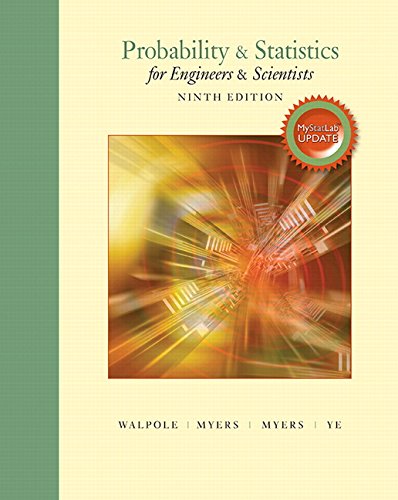
Probability & Statistics for Engineers & Scientists, MyStatLab Update (9th Edition), by Ronald E. Walpole, Raymond H. Myers, Sharon L. Mye

Ebook Probability & Statistics for Engineers & Scientists, MyStatLab Update (9th Edition), by Ronald E. Walpole, Raymond H. Myers, Sharon L. Mye
Probability & Statistics For Engineers & Scientists, MyStatLab Update (9th Edition), By Ronald E. Walpole, Raymond H. Myers, Sharon L. Mye. A work could obligate you to consistently enhance the understanding as well as encounter. When you have no adequate time to enhance it straight, you could get the encounter and also expertise from checking out the book. As everybody recognizes, book Probability & Statistics For Engineers & Scientists, MyStatLab Update (9th Edition), By Ronald E. Walpole, Raymond H. Myers, Sharon L. Mye is popular as the window to open up the globe. It suggests that reading book Probability & Statistics For Engineers & Scientists, MyStatLab Update (9th Edition), By Ronald E. Walpole, Raymond H. Myers, Sharon L. Mye will offer you a brand-new method to find everything that you require. As the book that we will certainly offer here, Probability & Statistics For Engineers & Scientists, MyStatLab Update (9th Edition), By Ronald E. Walpole, Raymond H. Myers, Sharon L. Mye
There is no question that book Probability & Statistics For Engineers & Scientists, MyStatLab Update (9th Edition), By Ronald E. Walpole, Raymond H. Myers, Sharon L. Mye will certainly constantly give you inspirations. Also this is just a book Probability & Statistics For Engineers & Scientists, MyStatLab Update (9th Edition), By Ronald E. Walpole, Raymond H. Myers, Sharon L. Mye; you could discover lots of categories and also sorts of publications. From amusing to journey to politic, as well as sciences are all provided. As exactly what we mention, here we provide those all, from well-known authors and also publisher around the world. This Probability & Statistics For Engineers & Scientists, MyStatLab Update (9th Edition), By Ronald E. Walpole, Raymond H. Myers, Sharon L. Mye is one of the compilations. Are you interested? Take it now. How is the way? Read more this article!
When someone should go to guide establishments, search shop by store, shelf by rack, it is very bothersome. This is why we offer the book collections in this internet site. It will certainly reduce you to look guide Probability & Statistics For Engineers & Scientists, MyStatLab Update (9th Edition), By Ronald E. Walpole, Raymond H. Myers, Sharon L. Mye as you such as. By searching the title, publisher, or writers of guide you desire, you could find them swiftly. In the house, office, or even in your means can be all ideal area within internet connections. If you intend to download the Probability & Statistics For Engineers & Scientists, MyStatLab Update (9th Edition), By Ronald E. Walpole, Raymond H. Myers, Sharon L. Mye, it is extremely simple then, due to the fact that currently we extend the link to buy and make offers to download and install Probability & Statistics For Engineers & Scientists, MyStatLab Update (9th Edition), By Ronald E. Walpole, Raymond H. Myers, Sharon L. Mye So very easy!
Curious? Certainly, this is why, we suppose you to click the web link page to go to, and after that you can delight in guide Probability & Statistics For Engineers & Scientists, MyStatLab Update (9th Edition), By Ronald E. Walpole, Raymond H. Myers, Sharon L. Mye downloaded and install till completed. You can conserve the soft documents of this Probability & Statistics For Engineers & Scientists, MyStatLab Update (9th Edition), By Ronald E. Walpole, Raymond H. Myers, Sharon L. Mye in your device. Obviously, you will bring the gizmo almost everywhere, won't you? This is why, whenever you have spare time, each time you can delight in reading by soft duplicate publication Probability & Statistics For Engineers & Scientists, MyStatLab Update (9th Edition), By Ronald E. Walpole, Raymond H. Myers, Sharon L. Mye
For junior/senior undergraduates taking probability and statistics as applied to engineering, science, or computer science.
This classic text provides a rigorous introduction to basic probability theory and statistical inference, with a unique balance between theory and methodology. Interesting, relevant applications use real data from actual studies, showing how the concepts and methods can be used to solve problems in the field. This revision focuses on improved clarity and deeper understanding.
This latest edition is also available in as an enhanced Pearson eText. This exciting new version features an embedded version of StatCrunch, allowing students to analyze data sets while reading the book.
Also available with MyStatLab
MyStatLab™ is an online homework, tutorial, and assessment program designed to work with this text to engage students and improve results. Within its structured environment, students practice what they learn, test their understanding, and pursue a personalized study plan that helps them absorb course material and understand difficult concepts.
Note: You are purchasing a standalone product; MyLab™ & Mastering™ does not come packaged with this content. Students, if interested in purchasing this title with MyLab & Mastering, ask your instructor for the correct package ISBN and Course ID. Instructors, contact your Pearson representative for more information.
If you would like to purchase both the physical text and MyLab & Mastering, search for:
0134468910 / 9780134468914 Probability & Statistics for Engineers & Scientists, MyStatLab Update with MyStatLab plus Pearson eText -- Access Card Package 9/e
Package consists of:
0134115856 / 9780134115856 Probability & Statistics for Engineers & Scientists, MyStatLab Update
0321847997 / 9780321847997 My StatLab Glue-in Access Card
032184839X / 9780321848390 MyStatLab Inside Sticker for Glue-In Packages
- Sales Rank: #5942 in Books
- Published on: 2016-03-17
- Original language: English
- Number of items: 1
- Dimensions: 9.20" h x 1.20" w x 7.40" l, .0 pounds
- Binding: Hardcover
- 816 pages
From the Back Cover
This classic book provides a rigorous introduction to basic probability theory and statistical inference that is motivated by interesting, relevant applications. It assumes readers have a background in calculus, and offers a unique balance of theory and methodology. Chapter topics cover an introduction to statistics and data analysis, probability, random variables and probability distributions, mathematical expectation, some discrete probability distributions, some continuous probability distributions, functions of random variables, fundamental sampling distributions and data descriptions, one- and two-sample estimation problems, one- and two-sample tests of hypotheses, simple linear regression and correlation, multiple linear regression and certain nonlinear regression models, one factor experiments: general, factorial experiments (two or more factors), 2k factorial experiments and fractions, nonparametric statistics, and statistical quality control. For individuals trying to apply statistical concepts to real-life, and analyze and interpret data.
Excerpt. © Reprinted by permission. All rights reserved.
Goals, Approach and Mathematical Level
The seventh edition emphasizes and illustrates the use of probabilistic models and statistical methodology that is employed in countless applications in all areas of science and engineering. There remains an important balance between theory and methodology that is featured in the text. We do not avoid the use of some theory but our goal is to let the mathematics provide insight rather than be a distraction. We feel that engineers and scientists are trained in mathematics and thus the providing of mathematical support when needed keeps the pedagogy from becoming a series of illustrated recipes in which the concepts are not understood and could never be applied or extended by the student except within very narrow bounds.
The text contains an abundance of exercises in which the methodology discussed is illustrated by the use of real-life scientific scenarios and data sets. The complete set of data files which accompany the text are available for download from the text companion website, located at http://www.prenhall.com/walpole. Though we attempt to appeal to engineers, the exercises are not confined to engineering applications. The student is exposed to problems encountered in many sciences including social sciences and biomedical applications. The motivation here stems from the fact that trained engineers are more and more becoming exposed to nontraditional settings, including areas like bioinformatics and bioengineering.
While we do let calculus play an important role but it should be noted that its use is confined to elementary probability theory and properties of probability distributions (Chapters 3, 4, 6, and 7). In addition, a modest amount of matrix algebra is used to support the linear regression material in Chapters 11 and 12. This is despite the fact that an "optional" section appears in Chapter 11 that includes the development of the multiple linear regression model with more substantive use of matrices. The student who uses this text should have completed one semester or two quarters of differential and integral calculus. An exposure to matrix algebra would be helpful but not necessary if the course content excludes the aforementioned optional section.
Content and Course Planning The text is designed for either a one or two semester course. A reasonable curriculum for a one semester course might include Chapters 1 through 10. One may even choose to teach an early portion of Chapter 11 in order to introduce the student to the concept of simple linear regression. Chapter 1 is an overview of statistical inference, sampling and data analysis. Indeed, some very rudimentary aspects of experimental design are included, along with an appreciation of graphics and certain vital characteristics of data collection. Chapters 2, 3, and 4 deal with basic probability and discrete and continuous random variables. Chapters 5 and 6 cover specific discrete and continuous distributions with illustrations of their use and relationships among them. Chapter 7 deals with transformations of random variables. This chapter is listed as "optional" and would only be covered in a more theoretical course. This chapter is clearly the most mathematical chapter in the text. Chapter 8 includes additional material on graphical methods as well as an introduction to the notion of a sampling distribution. The t and F distributions are introduced along with motivation regarding their use in chapters that follow. Chapters 9 and 10 contain material on one and two sample point and interval estimation and hypothesis testing. The flexibility in a single semester course lies in the option of exclusion of Chapter 7 as well as teaching only a subset of the several specific discrete and continuous distributions discussed and illustrated in Chapters 5 and 6. There is additional flexibility involved in dealing with Chapter 9 where maximum likelihood and Bayes estimation are covered in detail. An instructor may decide to give only a cursory development of one or both of these topics. In addition, estimation in Chapter 9 includes new material on prediction intervals and tolerance intervals along with a thorough discussion on the distinction among them, with examples. Flexibility may be exercised here.Chapters 11-17 contain ample material for a second semester of a two-semester course. Chapters 11 and 12 cover simple and multiple linear regression respectively. However, Chapter 12 contains new material that deals with special nonlinear models involved when one deals with nonnormal responses. As a result, logistic and Poisson regression are treated along with important practical illustrations. This in addition to new material in categorical variable regression again provides considerable flexibility for the instructor in his or her treatment of regression. The treatment of regression in this text is extensive and many special regression topics in Chapter 12 are self-contained. Chapters 13 through 17 contain topics in analysis of variance, design of experiments, nonparametric statistics, and quality control.
Case Studies and Computer SoftwareAs in previous editions there are many case studies that demonstrate statistical analysis of interesting real-life data sets. In most cases graphical techniques are used. These case studies are featured in two sample hypothesis testing, multiple linear regression, analysis of variance, and the analysis of 2-level experimental designs. Where appropriate, the use of residual plots, quantile plots, and normal probability plots are described in the analysis. Computer output is used for illustration purposes for these case studies and for other examples in the text. In that regard both SAS and MINITAB are featured. We have always felt that the experience of reading computer printout is invaluable to the student even if the package or packages featured in the text are not what is used by the instructor. Exposure to more than one type of software can broaden the experience base for the student. There is certainly no reason to believe that the software in the course is that which he or she will be called upon to use in practice.
New To This EditionMost helpful customer reviews
2 of 2 people found the following review helpful.
Great Book, Odd Organization And Dry Explanations However
By Mitch
I purchased this text for use in my Probability & Statistics I course. This text is relatively small, which is something I love seeing these days (means I don't have to carry a large chronicle of the universe in my backpack all day).
The book is pretty well written, and gives ample examples for study material and to follow along with any lecture material you may have. It adequately covers all basic topics for Probability & Statistics alike, building on itself the entire way throughout the book.
There are plenty of review questions for each chapter, typically assigned for homework, and there are odd-number answers in the appendix in the rear, as well as tables you will need to use for the course. The solutions manual is also typically correct for this text, helping when you may have issues with homework or to assist when studying the material to check answers against.
I have two problems with this book that caused me to dock a star on the rating.
Firstly, the book is pretty dry in it's explanations. Probability & Statistics is a word-problem based course, with nothing but real-world examples to use for problems and all of these possible scenarios to use for questions to make sure students understand the concepts and so on, however this book really doesn't seem to try and make the topic remotely interesting, so hopefully your professor can handle that part. The book spends paragraphs explaining the topics and then throws some examples and review questions your way, but never seems to make any attempt to make it more interesting for you as the reader.
The second issue is the placement of the review questions. Unlike every text I have ever been through, this text does not place all chapter review problems between the end of said chapter and the beginning of the next chapter, instead it strings them out throughout the chapter itself and splits them up by section of the chapter and it becomes very confusing to try and find your homework review problems or to try and find problems to practice for study material.
1 of 1 people found the following review helpful.
REVIEW FOR E-BOOK VERSION- 2 licenses not enough
By Matthew S
This review is purely for the e- book version of this text and is not even of the text itself- I just started using it, but it seems like as good a place as any to leave a warning for any considering purchasing.
The publisher limits the book to be used on only 2 devices, which may not be a problem for most people, in which case disregard this review, but for some such as myself this is extremely frustrating. There is a big difference between allowing 2 devices and 3- I like to use my laptop when I am on campus, my phone when I cannot use my laptop, and when I get home, I like to use my main pc so I can sit at my desk.
I like using the kindle applications to read the textbooks, but I am going to have to find a new way to purchase textbooks, because 2 concurrent licenses is not enough for me.
1 of 1 people found the following review helpful.
Bad binding, good book.
By Amazon Customer
Using this book was a good replacement for my actual stats professor. Very easy to follow and the applied problems for engineering are easy to follow.
Cons: I know it's a used book, but me and another class mate of mine had issues with the binding coming loose. The table section at the end of my book is no longer attached (which was convienent for the class ironically).
If you can get your hands on a well-cared for version then this would be a solid stats book for Chem E.
Probability & Statistics for Engineers & Scientists, MyStatLab Update (9th Edition), by Ronald E. Walpole, Raymond H. Myers, Sharon L. Mye PDF
Probability & Statistics for Engineers & Scientists, MyStatLab Update (9th Edition), by Ronald E. Walpole, Raymond H. Myers, Sharon L. Mye EPub
Probability & Statistics for Engineers & Scientists, MyStatLab Update (9th Edition), by Ronald E. Walpole, Raymond H. Myers, Sharon L. Mye Doc
Probability & Statistics for Engineers & Scientists, MyStatLab Update (9th Edition), by Ronald E. Walpole, Raymond H. Myers, Sharon L. Mye iBooks
Probability & Statistics for Engineers & Scientists, MyStatLab Update (9th Edition), by Ronald E. Walpole, Raymond H. Myers, Sharon L. Mye rtf
Probability & Statistics for Engineers & Scientists, MyStatLab Update (9th Edition), by Ronald E. Walpole, Raymond H. Myers, Sharon L. Mye Mobipocket
Probability & Statistics for Engineers & Scientists, MyStatLab Update (9th Edition), by Ronald E. Walpole, Raymond H. Myers, Sharon L. Mye Kindle
0 komentar:
Posting Komentar