


Ebook Download OpenGL 4 Shading Language Cookbook - Second Edition, by David Wolff
You can conserve the soft file of this e-book OpenGL 4 Shading Language Cookbook - Second Edition, By David Wolff It will rely on your extra time as well as tasks to open as well as review this publication OpenGL 4 Shading Language Cookbook - Second Edition, By David Wolff soft file. So, you might not be terrified to bring this publication OpenGL 4 Shading Language Cookbook - Second Edition, By David Wolff all over you go. Just add this sot data to your device or computer disk to permit you review every time as well as everywhere you have time.
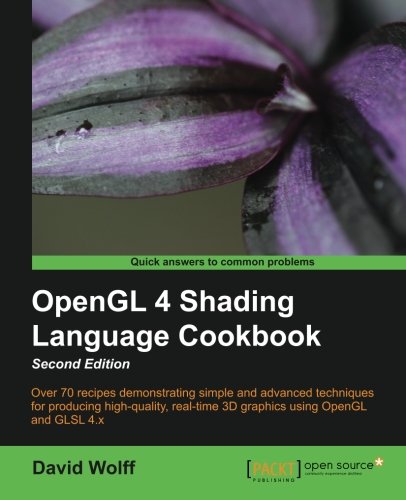
OpenGL 4 Shading Language Cookbook - Second Edition, by David Wolff

Ebook Download OpenGL 4 Shading Language Cookbook - Second Edition, by David Wolff
OpenGL 4 Shading Language Cookbook - Second Edition, By David Wolff When writing can alter your life, when creating can improve you by offering much cash, why don't you try it? Are you still quite confused of where getting the ideas? Do you still have no suggestion with just what you are going to write? Currently, you will need reading OpenGL 4 Shading Language Cookbook - Second Edition, By David Wolff A good writer is a great visitor at once. You can define how you create relying on what publications to check out. This OpenGL 4 Shading Language Cookbook - Second Edition, By David Wolff could assist you to address the issue. It can be one of the appropriate resources to create your creating ability.
If you want actually obtain guide OpenGL 4 Shading Language Cookbook - Second Edition, By David Wolff to refer currently, you need to follow this page consistently. Why? Keep in mind that you need the OpenGL 4 Shading Language Cookbook - Second Edition, By David Wolff source that will provide you appropriate expectation, do not you? By visiting this site, you have started to make new deal to always be up-to-date. It is the first thing you can begin to obtain all benefits from being in an internet site with this OpenGL 4 Shading Language Cookbook - Second Edition, By David Wolff and various other collections.
From currently, locating the completed site that sells the finished books will be several, however we are the trusted site to go to. OpenGL 4 Shading Language Cookbook - Second Edition, By David Wolff with very easy web link, simple download, and completed book collections become our better solutions to obtain. You can discover as well as use the advantages of picking this OpenGL 4 Shading Language Cookbook - Second Edition, By David Wolff as everything you do. Life is consistently developing as well as you need some new publication OpenGL 4 Shading Language Cookbook - Second Edition, By David Wolff to be reference consistently.
If you still need more publications OpenGL 4 Shading Language Cookbook - Second Edition, By David Wolff as references, going to look the title and also theme in this website is readily available. You will discover even more whole lots books OpenGL 4 Shading Language Cookbook - Second Edition, By David Wolff in various disciplines. You could likewise when feasible to check out the book that is already downloaded. Open it and also save OpenGL 4 Shading Language Cookbook - Second Edition, By David Wolff in your disk or device. It will certainly alleviate you wherever you need the book soft documents to read. This OpenGL 4 Shading Language Cookbook - Second Edition, By David Wolff soft data to read can be reference for everybody to enhance the skill and also ability.
Acquiring the skills of OpenGL Shading Language is so much easier with this cookbook. You'll be creating graphics rather than learning theory, gaining a high level of capability in modern 3D programming along the way.
Overview
- Discover simple and advanced techniques for leveraging modern OpenGL and GLSL
- Learn how to use the newest features of GLSL including compute shaders, geometry, and tessellation shaders
- Get to grips with a wide range of techniques for implementing shadows using shadow maps, shadow volumes, and more
- Clear, easy-to-follow examples with detailed explanations and full, cross-platform source code available from GitHub
In Detail
OpenGL Shading Language (GLSL) is a programming language used for customizing parts of the OpenGL graphics pipeline that were formerly fixed-function, and are executed directly on the GPU. It provides programmers with unprecedented flexibility for implementing effects and optimizations utilizing the power of modern GPUs. With Version 4, the language has been further refined to provide programmers with greater power and flexibility, with new stages such as tessellation and compute.
OpenGL 4 Shading Language Cookbook provides easy-to-follow examples that first walk you through the theory and background behind each technique, and then go on to provide and explain the GLSL and OpenGL code needed to implement it. Beginner level through to advanced techniques are presented including topics such as texturing, screen-space techniques, lighting, shading, tessellation shaders, geometry shaders, compute shaders, and shadows.
OpenGL Shading Language 4 Cookbook is a practical guide that takes you from the fundamentals of programming with modern GLSL and OpenGL, through to advanced techniques. The recipes build upon each other and take you quickly from novice to advanced level code.
You’ll see essential lighting and shading techniques; examples that demonstrate how to make use of textures for a wide variety of effects and as part of other techniques; examples of screen-space techniques including HDR rendering, bloom, and blur; shadowing techniques; tessellation, geometry, and compute shaders; how to use noise effectively; and animation with particle systems.
OpenGL Shading Language 4 Cookbook provides examples of modern shading techniques that can be used as a starting point for programmers to expand upon to produce modern, interactive, 3D computer graphics applications.
What you will learn from this book
- Compile, debug, and communicate with shader programs
- Use new features of GLSL 4 such as subroutines, sampler objects, and uniform blocks
- Implement core lighting and shading techniques such as diffuse and specular shading, per-fragment shading, and spotlights
- Use textures for a variety of effects including cube maps for reflection or refraction
- Implement screen-space techniques such as HDR, bloom, blur filters, order-independent transparency, and deferred shading
- Utilize noise in shaders
- Use shaders for animation
- Make use of compute shaders for physics, animation, and general computing
- Learn how to use new OpenGL features such as shader storage buffer objects, and image load/store
- Sales Rank: #640590 in Books
- Published on: 2013-12-24
- Released on: 2013-12-24
- Original language: English
- Number of items: 1
- Dimensions: 9.25" h x .89" w x 7.50" l, 1.49 pounds
- Binding: Paperback
- 394 pages
About the Author
David Wolff
David Wolff is an associate professor in the Computer Science and Computer Engineering Department at Pacific Lutheran University (PLU). He received a PhD in Physics and an MS in Computer Science from Oregon State University. He has been teaching computer graphics to undergraduates at PLU for over 10 years, using OpenG.
Most helpful customer reviews
2 of 2 people found the following review helpful.
Good source of topical information, not so good as an introduction
By Gabriel Yoder
Some others reviews have claimed this book is good for an introduction to modern opengl. Although it could be used for a such a purpose, I wouldn't recommend using it that way. The introduction portion is entirely in the first chapter and is awkwardly organized with too much emphasis on largely redundant shader examples with not enough emphasis on the opengl code required to use the shaders. Furthermore, the writing is super dry and suffers from some pacing issues (some minor things are explained in a drawn out matter while some more advanced items are glossed over).
That being said, there is a lot of useful information in this book and a lot of interesting topics are covered. This would make an excellent second book in your collection. Get your introduction from another book like "Anton's OpenGL 4 Tutorials", and use this book in the manner the title suggests - a cookbook with recipes for handling various topics.
4 of 4 people found the following review helpful.
Samples run and look great!
By AZach
Awesome book. The author is very helpful in fixing source code problems on GitHub as well. Samples are compact, organized, and intuitive to understand if you have experience with C++ and platform-independent windowing systems such as SFML, SDL, or in this case GLFW.
1 of 1 people found the following review helpful.
A clean introduction to Modern OpenGL
By Sriram Kashyap
I taught a beginners (undergrad) course on OpenGL Shading and this book was instrumental in making the course possible. It has very little fluff, is written in a very clean, well structured manner, and is easy to approach. The assumption is that people already know a good bit of programming and have some familiarity with Graphics APIs. I would say this is THE book to read for someone who is already familiar with legacy OpenGL and wants to upgrade to shader programming and new APIs.
OpenGL 4 Shading Language Cookbook - Second Edition, by David Wolff PDF
OpenGL 4 Shading Language Cookbook - Second Edition, by David Wolff EPub
OpenGL 4 Shading Language Cookbook - Second Edition, by David Wolff Doc
OpenGL 4 Shading Language Cookbook - Second Edition, by David Wolff iBooks
OpenGL 4 Shading Language Cookbook - Second Edition, by David Wolff rtf
OpenGL 4 Shading Language Cookbook - Second Edition, by David Wolff Mobipocket
OpenGL 4 Shading Language Cookbook - Second Edition, by David Wolff Kindle
0 komentar:
Posting Komentar